
Review · SELF-GUIDED TOURS
Self-Guided Tour of Ísafjörður: Art, History, and Architecture
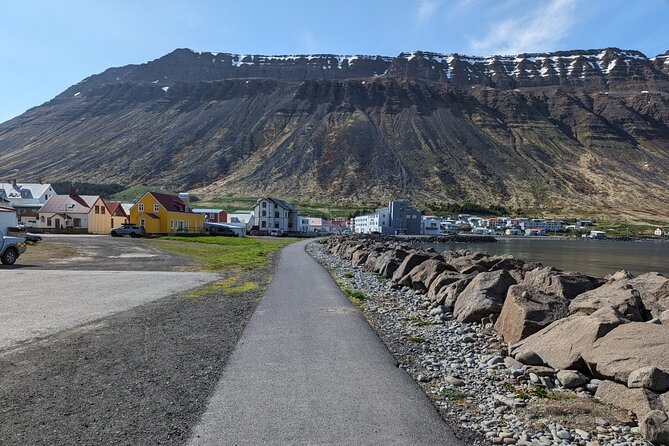
Ísafjörður rewards slow looking. This compact audio walk links the town’s fishing past with its modern art, unusual street design, old buildings, and local stories. I like the personal feel of a tour narrated by someone connected to the town, and I like that you can pause whenever you want. The main drawback is the app: you need to download the tour and check your phone settings before setting out, since GPS and playback can occasionally be temperamental.
I especially like the low $9.99 price and the freedom to take 75 to 90 minutes, or longer if you stop inside the museum or linger in the parks. It is a good choice if you want more context than a quick stroll provides but do not want to join a fixed group. Bring your own phone and headphones, and allow a few minutes to get VoiceMap working before you leave the starting point.
In This Review
- Key points at a glance
- Starting at the Westfjord History Museum
- From fishing boats to fish-skin medicine at Kerecis
- Ísafjarðarkirkja and the town’s sunny pancake story
- The old hospital, Sjúkrahúsið
- Jónsgarður and the Whalebone Arch
- The Fishermen’s Monument and the people behind the town
- The 3D Crosswalk adds a playful turn
- Culture House Eyrartún and local art
- Austurvöllur, a quiet garden with unusual connections
- Finishing at Silfurtorg town square
- How the VoiceMap app affects the experience
- Is $9.99 good value?
- Who should book this walk?
- Should you book the Ísafjörður audio tour?
- FAQ
- How long does the self-guided tour take?
- Where does the tour start and finish?
- What language is the audio tour offered in?
- Do I need to bring anything?
- Are museum tickets included?
- Can I cancel the booking?
Key points at a glance
- A local voice leads the way: Personal stories give the walk a more intimate feel than a standard fact sheet.
- The route connects old and new Ísafjörður: Fishing traditions sit alongside biotech, contemporary art, and playful street design.
- The Westfjord History Museum starts the story: You begin with the seafaring and fishing industries that shaped the town.
- The 3D Crosswalk and Whalebone Arch add fun photo stops: These unusual sights break up the historical material.
- Offline maps and audio are included: Download everything before walking so you are not dependent on a live connection.
- GPS may need help: If playback does not trigger, the app allows you to start each stop manually.
Starting at the Westfjord History Museum
The walk begins at the Westfjord History Museum, at 400 Ísafjörður. This is a sensible starting point because the museum explains the forces that made Ísafjörður what it is: fishing, boats, seafaring, and the hard work of life around the Westfjords.
The audio introduction helps you see the town through that working past rather than treating it as a pretty collection of old houses. You can visit the museum if it suits your schedule, but admission is not included in the tour price. If you plan to go inside, set aside extra time beyond the stated 75 to 90 minutes.
That flexibility is one of the strongest parts of this experience. You can pause the narration, look around, enter an attraction, take photographs, and resume when ready. You are not trying to keep up with a guide or a group.
The walk is offered in English. Since it is a private activity for your own group, you do not have to share the pace or the audio with strangers. It is still self-guided, so the quality of your experience depends partly on preparing your phone before you arrive.
More history tours in Iceland:
- Funky History Walking Tour in Reykjavik – With local storyteller
★ 5.0 · 389 reviews - Ancient Historical Site Tour at the Caves of Hella
★ 4.5 · 191 reviews
From fishing boats to fish-skin medicine at Kerecis
The next part of the route brings Ísafjörður’s old fishing economy into the present. You pass Kerecis, a successful Icelandic biotechnology company known for using fish skin in medical treatments.
The company is described as Iceland’s only unicorn, meaning a privately held business valued at more than one billion dollars. That modern achievement makes a useful contrast with the museum’s boats and fishing stories. The same sea that supported generations of fishermen now supplies material for advanced medical products.
You do not enter Kerecis as part of the tour, so this is a pass-by stop rather than a full company visit. Still, it gives the route a broader point: Ísafjörður is not simply preserving its past. It is also finding new uses for an old local resource.
I like this stop because it adds substance to the walk. You are not only looking at historic façades. You are also hearing how a small town’s economic identity can change without losing its connection to the sea.
Ísafjarðarkirkja and the town’s sunny pancake story
Next comes Ísafjarðarkirkja, the town church. The audio explains the unusual story behind its name and its links to the sun and pancakes, a small cultural detail that would be easy to miss if you were walking without commentary.
This is exactly where an audio tour earns its modest price. A church can look attractive from the outside, but its name and local associations give you something to remember. The story also adds a bit of humor to an otherwise formal building.
The tour focuses on the church and its context rather than promising an included interior visit. If the church is open and you choose to go inside, remember that any entrance costs are your responsibility. The route information does not include admission to museums or other attractions.
Keep your eyes on the building as the narration plays. The best self-guided walks do not force you to stare at a screen, and this one is designed to let you listen while taking in the streets around you.
The old hospital, Sjúkrahúsið
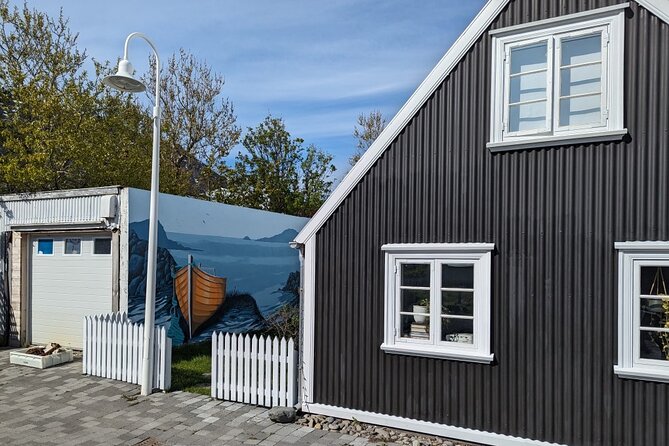
The route then passes the picturesque old hospital, Sjúkrahúsið. Its value is architectural as much as historical. The well-kept building adds another layer to Ísafjörður, showing how public institutions once fit into the town’s daily life.
This is a good stop for anyone who enjoys buildings that are not grand landmarks but still help explain a place. You get a sense of the town’s scale and character from structures like this. The old hospital also provides a visual pause after the church and the more industrial story of Kerecis.
Since you pass by rather than take part in a scheduled interior tour, your experience here is quick and outward-looking. That suits the overall design. This is a town walk, not a series of formal admissions, and it keeps moving through the streets.
More self-guided routes in Iceland:
- South Coast Iceland from Reykjavik with Guide & Touchscreen Audio
★ 4.5 · 330 reviews - Hellisheiði Geothermal Exhibition: Entry and Audio Tour
★ 4.6 · 88 reviews - Reykjavik Main Sights and Hidden Spots: A Self-Guided Audio Walk
★ 4.5 · 39 reviews - Iceland’s Golden Circle Self-Guided Audio Driving Tour
★ 4.5 · 38 reviews
Jónsgarður and the Whalebone Arch
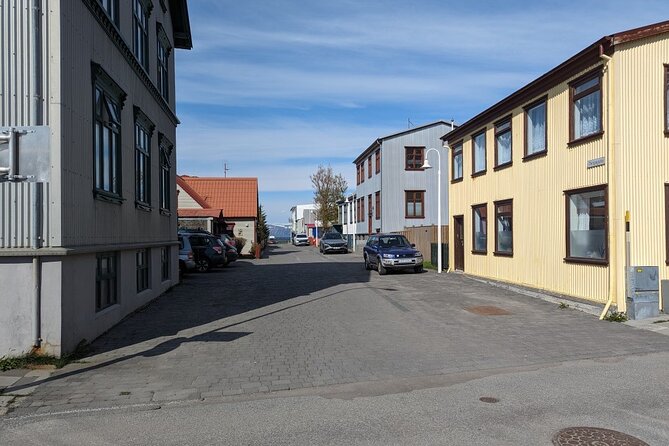
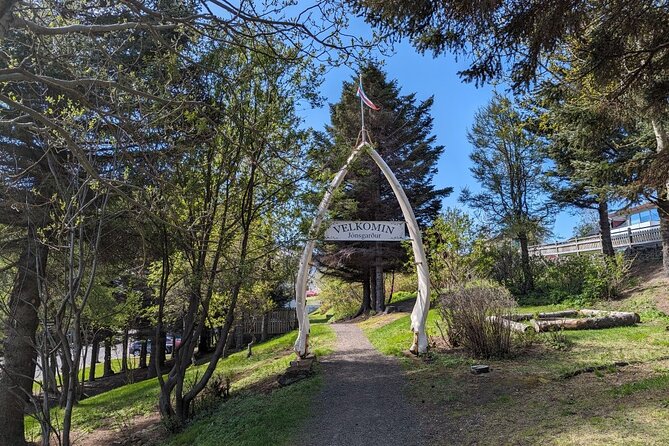
At Jónsgarður park, you get a chance to slow down. The park is a pleasant green space, and its best-known feature is the Whalebone Arch, a natural-history object turned photo stop.
The arch gives the route one of its most memorable images. It also connects neatly with the town’s relationship to the sea, although the tour’s larger story is about fishing and seafaring rather than whale watching.
This is a useful place to pause the app. Sit for a moment, take a photograph, or simply enjoy a break from walking. The self-guided format works well here because you are not holding up anyone if you need extra time.
I would not rush through Jónsgarður just to stick to the estimated finish time. The route is only about an hour and a quarter to an hour and a half at a normal pace, but the app gives you unlimited use. You can return to the audio before or after your booking date, and you can replay it later like an audiobook.
The Fishermen’s Monument and the people behind the town
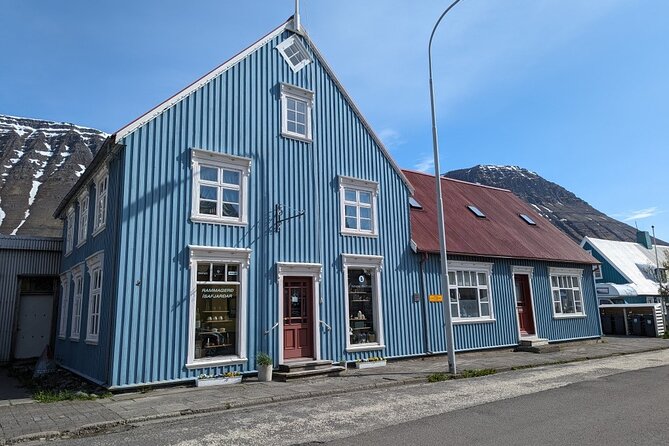
The Fishermen’s Monument is a large bronze sculpture honoring the town’s fishing heritage and the seafarers who helped build its prosperity. It gives the walk a more human focus.
The museum introduces an industry. The monument brings attention back to the people who worked in it. Together, the two stops help you understand that fishing was not simply an occupation in Ísafjörður. It shaped the town’s fortunes, identity, and relationship with the water.
Large public sculpture can sometimes feel disconnected from its setting. Here, the subject fits the town. You are still close to the streets and buildings that grew around the fishing economy, so the monument does not feel like an isolated art object.
I appreciate that the route includes art without separating it from local life. You get public art, architecture, and history in the same walk, with each stop helping explain the next.
The 3D Crosswalk adds a playful turn
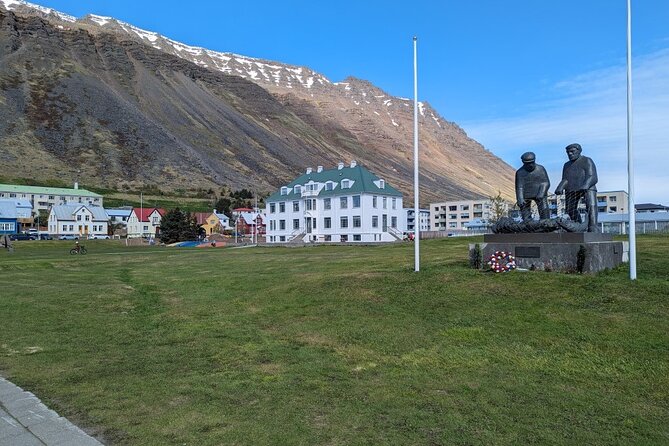
The famous 3D Crosswalk changes the mood. Designed to look as if its stripes are floating above the road, it is a clever piece of street art and an easy photo opportunity.
After the museum, church, hospital, park, and monument, this crossing keeps the route from becoming too solemn. Ísafjörður’s story is not only about work, hardship, and old buildings. It also includes modern design and a willingness to have fun with public space.
Use care when taking pictures, since this is still a crosswalk. The tour identifies it as a visual effect, not an attraction with an entrance or a long visit. A few minutes is enough, but it is one of the stops you are likely to remember.
The 3D Crosswalk also shows why walking is the right way to experience this tour. From a vehicle, it would be easy to miss the illusion entirely. On foot, you can stand at the right angle and see how the painted stripes create the floating effect.
Culture House Eyrartún and local art
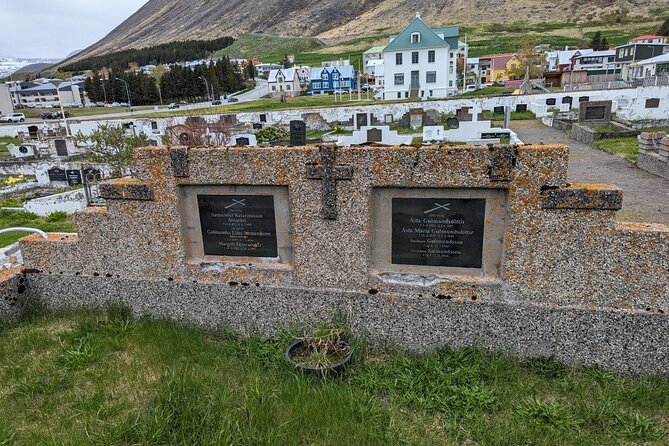
The route passes Culture House Eyrartún, a venue where local artists exhibit their work. This stop brings contemporary Icelandic art into a walk that began with maritime history.
The information provided does not promise a special exhibition, guided visit, or included admission. Think of Eyrartún as a place to notice and investigate if the doors are open, not as a guaranteed indoor activity included in the $9.99 fee.
That distinction matters when planning your time. The tour itself remains available throughout the day, but the chance to see inside a venue can depend on its own opening arrangements. The supplied hours for the overall experience are listed as Monday through Sunday, all day, but that does not guarantee that every attraction along the route will be open.
Even from outside, the stop makes the town feel more current. You are seeing a place where local artists have room to show their work, not just a preserved historic district.
Austurvöllur, a quiet garden with unusual connections
At Austurvöllur garden, the commentary turns toward the town’s president and an infamous volcano. The pairing sounds unusual, which is part of the appeal. This stop links local political life with Iceland’s powerful volcanic setting.
The garden offers a quieter stretch near the end of the route. After several points of interest, it gives you a place to pause and let the stories settle. You may want to stop the audio briefly if you prefer to enjoy the garden without narration.
The tour’s approach is strongest when it connects small local details to larger Icelandic themes. A garden, a president, and a volcano might seem unrelated at first, but together they show how public spaces can carry several layers of meaning.
Finishing at Silfurtorg town square
The walk ends at Silfurtorg, the central town square, at Aðalstræti 27. This is the natural finish: a central place where you can continue exploring, find a place to sit, or simply take in the town after hearing its story.
Ending in the square also gives the route a clear shape. You begin with the maritime past at the museum and finish in the social center of town. Along the way, you move through religion, public buildings, gardens, sculpture, business, and art.
The walk is not designed to cover every corner of Ísafjörður. Its strength is the carefully chosen chain of stops. You get a practical introduction in a short time, with enough variety to keep the route interesting.
How the VoiceMap app affects the experience
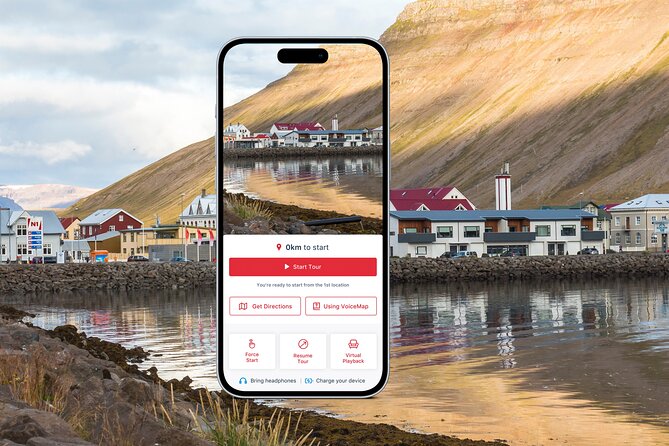
The app is the one part I would prepare carefully. Download the audio, maps, and geographic data before starting. Offline access is included, which is useful if your phone connection is weak or you want to avoid relying on mobile data.
The tour uses GPS to trigger the narration as you reach each point. That can feel wonderfully hands-free when it works, but the GPS may occasionally misread your position. If the next section does not begin, you can start the audio manually from the relevant stop.
You should also check your iPhone or phone settings and make sure the app has the permissions it needs. Two people listening on separate phones may not remain perfectly synchronized if their settings differ. For that reason, one person can operate the tour while the other listens, or both of you can test playback before leaving the museum.
Bring headphones, since they are not supplied. A fully charged phone is also sensible, though the tour information does not state a specific battery requirement. The app lets you pause and restart, so you can take your time rather than treating the route as a race.
Is $9.99 good value?
At $9.99 per person, this is a reasonably priced introduction to Ísafjörður. You get a 75 to 90 minute route, audio commentary, directions to the starting point, offline maps and data, and unlimited lifetime access before and after your selected date.
The value improves if you are traveling on your own schedule. A conventional guided walk may require you to fit a fixed departure time into your day. Here, you choose when to begin, how long to pause, and whether to replay sections later.
The price does not include museum tickets or other entrance fees. That keeps the basic cost low, but you should budget separately if you want to enter the Westfjord History Museum or any venue along the route.
I see this as a good purchase for two kinds of people: those with only a few hours in town and those who prefer private exploration. If you already know Ísafjörður well, the tour may feel less useful. If this is your first visit, the mix of local stories and visible landmarks gives you a solid orientation.
Who should book this walk?
I would choose it if you like walking, local anecdotes, and the freedom to stop without asking permission. It suits couples, families, and small private groups who want to explore together without a live guide setting the pace.
It is also a good fit if you want to see more than the obvious sights. Kerecis, the old hospital, Austurvöllur, and the 3D Crosswalk add details you might pass without context. The route gives you reasons to notice them.
You should think twice if you dislike phone-based tours or find GPS apps frustrating. The technical setup is not difficult, but it does require attention before you begin. Anyone needing a fully guided, face-to-face experience would be better served by a traditional walking tour.
Most people can participate, and service animals are allowed. The experience is private, but it is not a vehicle tour or an escorted excursion. You are responsible for following the route on foot and managing your own stops.
Should you book the Ísafjörður audio tour?
Book it if you want an affordable, personal introduction to the town in about 90 minutes. The strongest features are the local narration, the mix of maritime history and modern culture, and the freedom to pause at the museum, parks, and photo stops.
Before you commit, download the tour and test the app. If you do that, the occasional GPS problem is manageable. For $9.99, you get more than a list of landmarks: you get a route that explains how fishing, public life, art, business, and Icelandic stories meet in one small Westfjords town.
FAQ
How long does the self-guided tour take?
The walk takes approximately 1 hour and 15 minutes to 1 hour and 30 minutes. Extra time is needed if you enter the museum or stop at other attractions along the way.
Where does the tour start and finish?
It starts at the Westfjord History Museum, 400 Ísafjörður. It ends at Silfurtorg, the town square, at Aðalstræti 27.
What language is the audio tour offered in?
The tour is offered in English.
Do I need to bring anything?
You need your own smartphone and headphones. It is also important to download the audio, maps, and geographic data for offline use before beginning.
Are museum tickets included?
No. Tickets or entrance fees for museums and other attractions along the route are not included.
Can I cancel the booking?
Yes. You can cancel at least 24 hours before the experience start time for a full refund. Cancellations or changes made less than 24 hours before the start time are not accepted for a refund.
Added around Iceland recently
- Akureyri: Whale Watching Shore Excursions★ 4.6 · 250 reviews
- Reykjavik: Whale and Puffin Watching RIB Boat Tour★ 4.6 · 179 reviews
- Reykjavik: Whale Watching & Lava Show★ 5.0 · 4 reviews
- Akureyri: Whale Watching Tour & Forest Lagoon Entrance★ 3.8 · 4 reviews
- Westman Islands Day Tour from Reykjavik★ 5.0 · 2 reviews
- Reykjavik: Whale & Marine Adventure Tour★ 4.3 · 71 reviews
- Reykjavik: Whale Watching Express★ 4.3 · 227 reviews
- West Glacial River Family Rafting★ 5.0 · 9 reviews
Self-Guided Tours, compared.

South Coast Iceland from Reykjavik with Guide & Touchscreen Audio
Read our review →
Hellisheiði Geothermal Exhibition: Entry and Audio Tour
Read our review →
Reykjavik Main Sights and Hidden Spots: A Self-Guided Audio Walk
Read our review →
Iceland’s Golden Circle Self-Guided Audio Driving Tour
Read our review →
Reykjavik Scavenger Hunt and Highlights Self Guided Audio Tour
Read our review →
Snaefellsnes Peninsula Self-Guided Driving Audio Tour
Read our review →
Reykjanes Peninsula: Volcanos & Blue Lagoon Self-Guided Tour
Read our review →Browse the lists this tour appears in